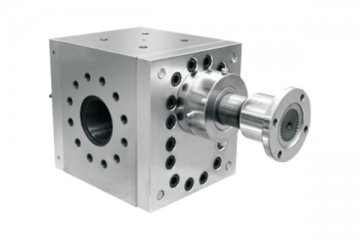
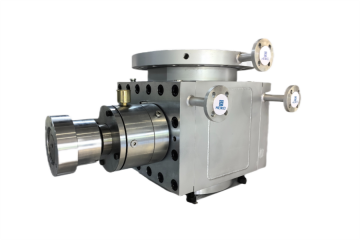
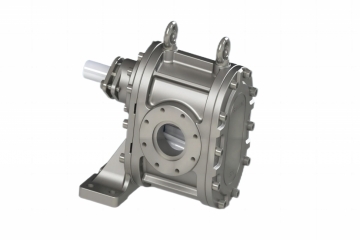
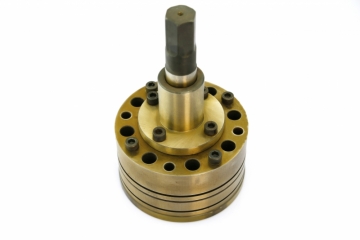
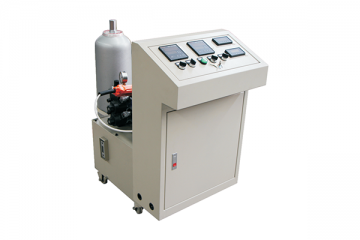
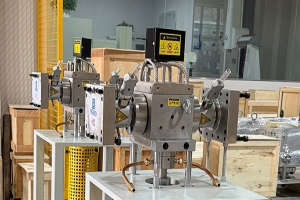
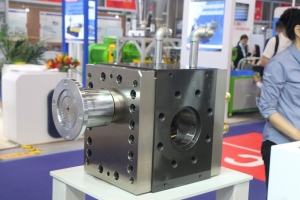
As a critical piece of equipment, rubber extrusion melt pumps play a vital role in the rubber processing industry. By precisely controlling the flow and pressure of the rubber melt, they significantly enhance production efficiency and product quality. The core advantage of this equipment lies in its unique design and operating principles, which effectively address many of the challenges associated with traditional extrusion processes.
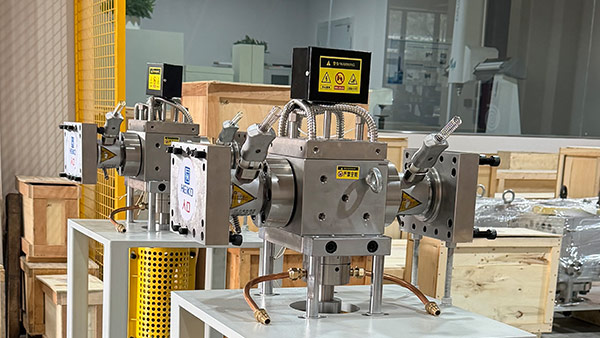
First, rubber extrusion melt pumps offer exceptional pressure stability. In traditional extrusion processes, pressure fluctuations in the rubber melt can easily lead to inconsistent product dimensions or surface defects. However, through the precise meshing of gears, the melt pump converts the unstable melt pressure from the extruder into a stable output. This pressure stability is particularly crucial for producing high-precision rubber products, such as automotive seals and medical catheters, which require strict dimensional tolerances. According to actual production data, the use of melt pumps can control product dimensional variation within ±0.5%, far surpassing the ±3% tolerance of traditional processes.
Second, this equipment significantly improves production efficiency. In traditional extrusion processes, production speed often needs to be reduced to achieve stable output. However, the introduction of melt pumps allows production lines to increase output by 30%–50% while maintaining high quality. This is primarily due to the homogenizing effect of the melt pump, which eliminates the pulsating fluctuations generated by the extruder, making the extrusion process smoother and more continuous. After adopting melt pumps, a major rubber products manufacturer increased the annual production capacity of a single production line by approximately 200 tons, yielding significant economic benefits.
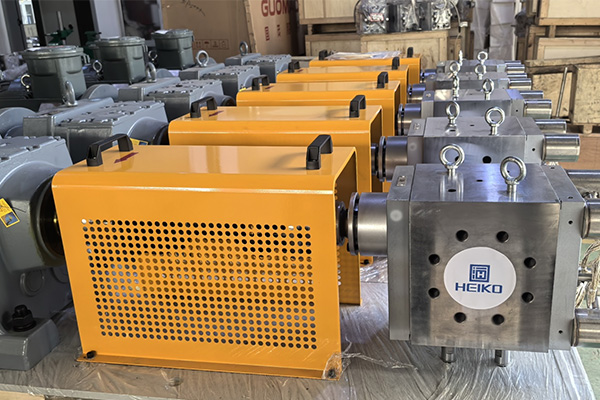
In terms of energy conservation and reduced consumption, rubber extrusion melt pumps demonstrate clear advantages. Because they can precisely control melt pressure, the extruder can operate at lower back pressure, thereby reducing energy consumption by 15%–20%. Additionally, the melt pumps themselves feature a high-efficiency drive design, resulting in minimal power loss. According to statistics, a medium-sized rubber extrusion production line can save approximately 50,000 kWh of electricity annually, equivalent to a reduction of over 40 tons of carbon emissions. This is particularly important in today’s industrial environment, which emphasizes green manufacturing.
Rubber extrusion melt pumps also offer excellent adaptability. They can process various types of rubber, ranging from soft to hard, including natural rubber, styrene-butadiene rubber (SBR), and ethylene-propylene rubber (EPR). Even for special formulations, such as rubber filled with a high proportion of carbon black, the melt pump maintains stable delivery. This broad adaptability eliminates the need for frequent parameter adjustments when switching between different product lines, significantly enhancing production flexibility. A report from a multinational rubber company indicates that, following the adoption of melt pumps, product changeover time was reduced by an average of 40%.
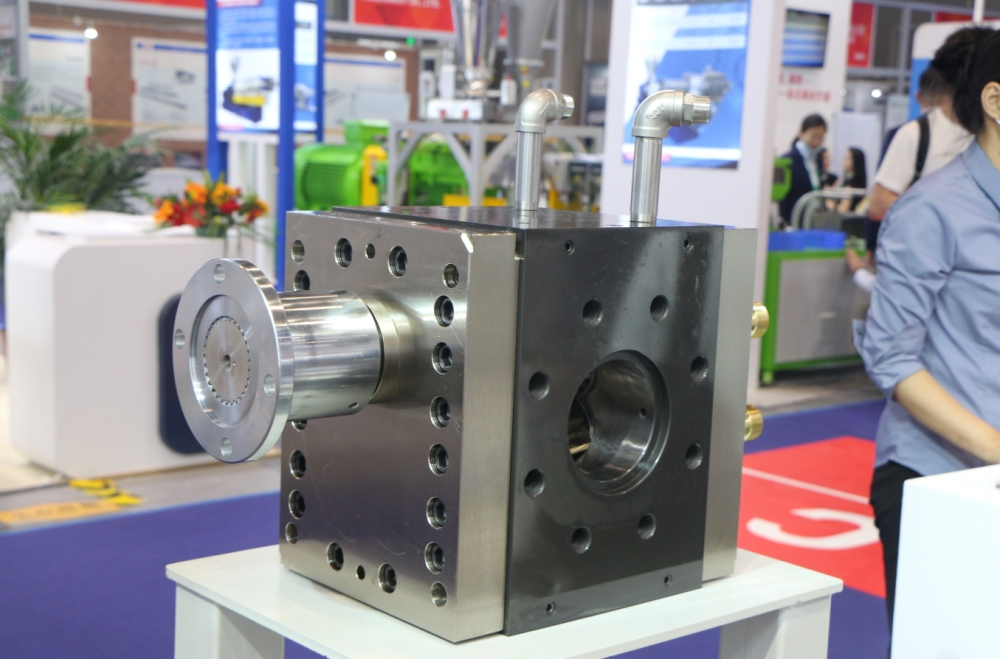
From the perspective of product quality, the improvements brought by melt pumps are particularly notable. They effectively eliminate air bubbles and unplasticized particles in the melt, resulting in denser and more uniform products. For products requiring high surface finish, such as automotive door and window seals, surface roughness can be reduced by more than 30% when using melt pumps. Furthermore, as the extrusion process becomes more stable, the consistency of product physical properties is significantly improved; batch-to-batch variations in key indicators such as tensile strength and elongation can be controlled within 5%.
In practical applications, the selection of a rubber extrusion melt pump is also critical. Pump specifications must be determined by comprehensively considering factors such as product characteristics, production requirements, and factory conditions. Generally, small pumps are suitable for output rates below 200 kg/h, medium-sized pumps for 200–800 kg/h, and large or custom models for rates exceeding 800 kg/h. At the same time, compatibility with other equipment, such as extruders and molds, requires professional evaluation to ensure the coordinated operation of the entire system.