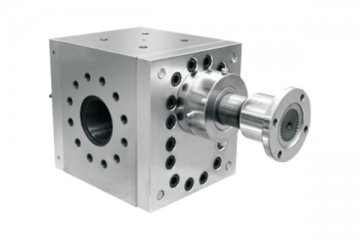
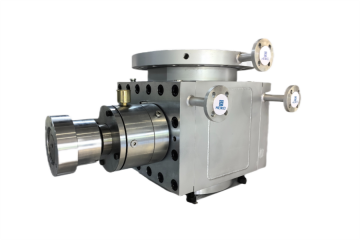
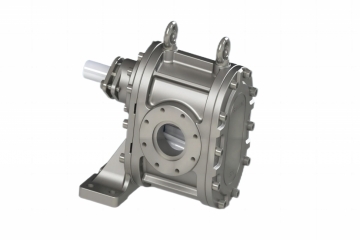
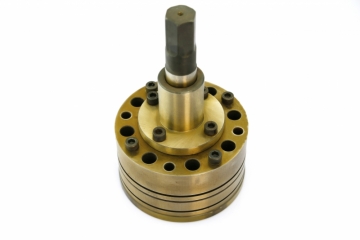
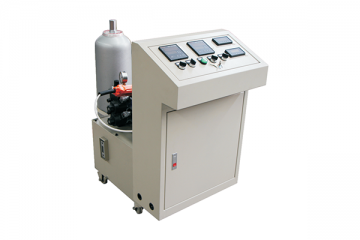
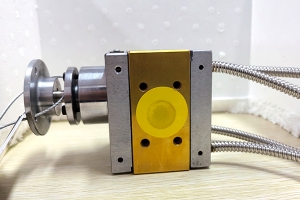
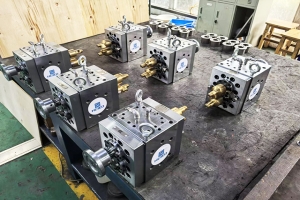
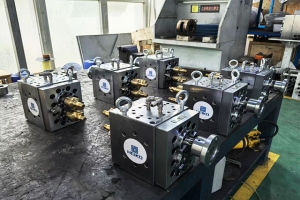
As a critical precision component in plastic wire drawing production lines, the melt metering pump utilizes the positive displacement principle of positive displacement gear drives to ensure precise, stable, and homogeneous melt delivery for the production line. They effectively address the common challenges of flow and pressure instability caused by extruder screw pulsation and fluctuations in material temperature and viscosity. By comprehensively optimizing the drawing process across three key dimensions—wire quality, production efficiency, and equipment maintenance—these pumps can flexibly accommodate various materials such as PE, PP, and PVC, as well as diverse drawing specifications including round, flat, and multi-strand wires. Their specific functions can be summarized as follows:
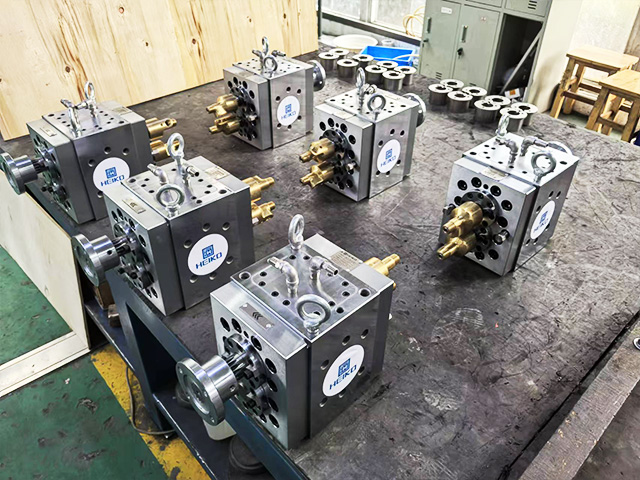
Precise Metering and Stable Flow: It enables precise, metered delivery of the melt, controlling flow rate errors within an extremely narrow range. This effectively offsets various process fluctuations caused by extruder operation and changes in material properties, ensuring a constant melt supply to the die. This guarantees high uniformity in wire diameter and weight from the source, completely eliminating appearance defects such as variations in wire thickness, and laying the foundation for high-quality wire production.
Stable Pressure, Buffering, and Defect Prevention: It establishes and maintains a constant melt pressure at the die, efficiently buffering the periodic pressure pulsations generated by the extruder screw’s operation. This prevents quality issues such as filament breakage, stringing, and bubbles caused by sudden pressure changes, ensuring the continuous and stable operation of high-speed drawing and cooling/stretching processes, and significantly improving the surface finish and internal mechanical strength of the filament.
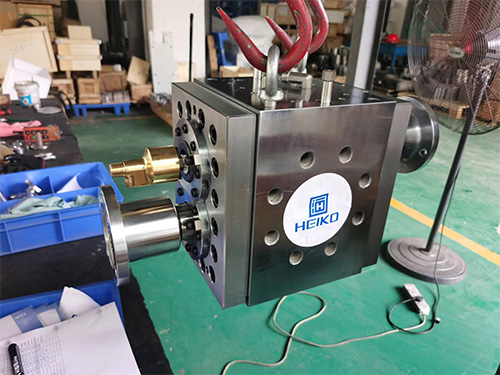
Shear Mixing for Homogenization: Within the pump chamber, the melt undergoes multiple shear actions, thorough agitation, and uniform mixing through precise gear meshing. This effectively reduces internal temperature gradients, minimizes impurities and bubbles in the melt, and promotes uniform dispersion of molecular chains, further enhancing the intrinsic quality of the filament. It fully meets the stringent quality requirements of downstream processes such as braiding and winding.
Load Reduction, Efficiency Enhancement, and Equipment Protection: By actively bearing the primary pressure load during melt conveyance, this system significantly reduces backpressure and torque on the extruder screw, minimizes wear and tear on critical equipment components, lowers energy consumption per unit of product, and effectively extends the service life of core equipment such as the extruder. Simultaneously, it enables production lines to operate at higher speeds, reduces the frequency of unplanned downtime, lowers scrap rates, and comprehensively improves overall production efficiency and economic benefits.
Flexible Adaptation to Multiple Scenarios: The melt output flow rate maintains a strict linear relationship with the pump’s rotational speed. By utilizing variable-frequency speed control, the melt supply can be quickly and precisely adjusted, significantly shortening the time required for process switching and debugging when handling wires of different specifications and materials. Furthermore, it can be flexibly integrated with extruders, screen changers, and various mold specifications to accommodate the production needs of multi-material and multi-category wire drawing, thereby significantly enhancing the production line’s capacity utilization and application scope while increasing production flexibility.
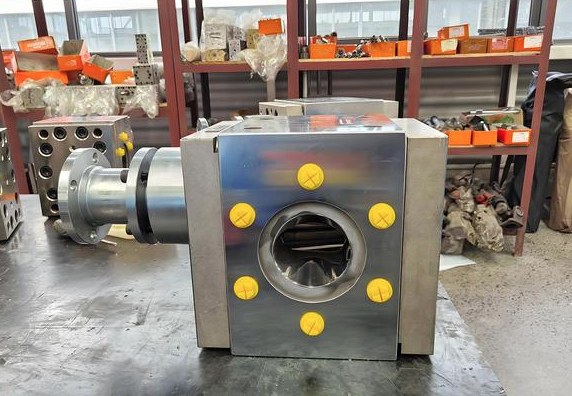
Overall, the application of melt metering pumps is a key enabler for achieving high-precision, high-stability, high-efficiency, and high-yield continuous production in plastic filament drawing lines. It is also a core configuration for enhancing the market competitiveness of filament products and driving the quality improvement, efficiency enhancement, and upgrading of production lines.